
Villa Waterproofing in Bali: What Evidence to Ask For
Waterproofing is buried within weeks of being laid. What to ask a Bali developer for, stage by stage: below-grade membranes before backfill, flood tests before tiling, roof and terrace details, the pool shell, and the warranty wording.
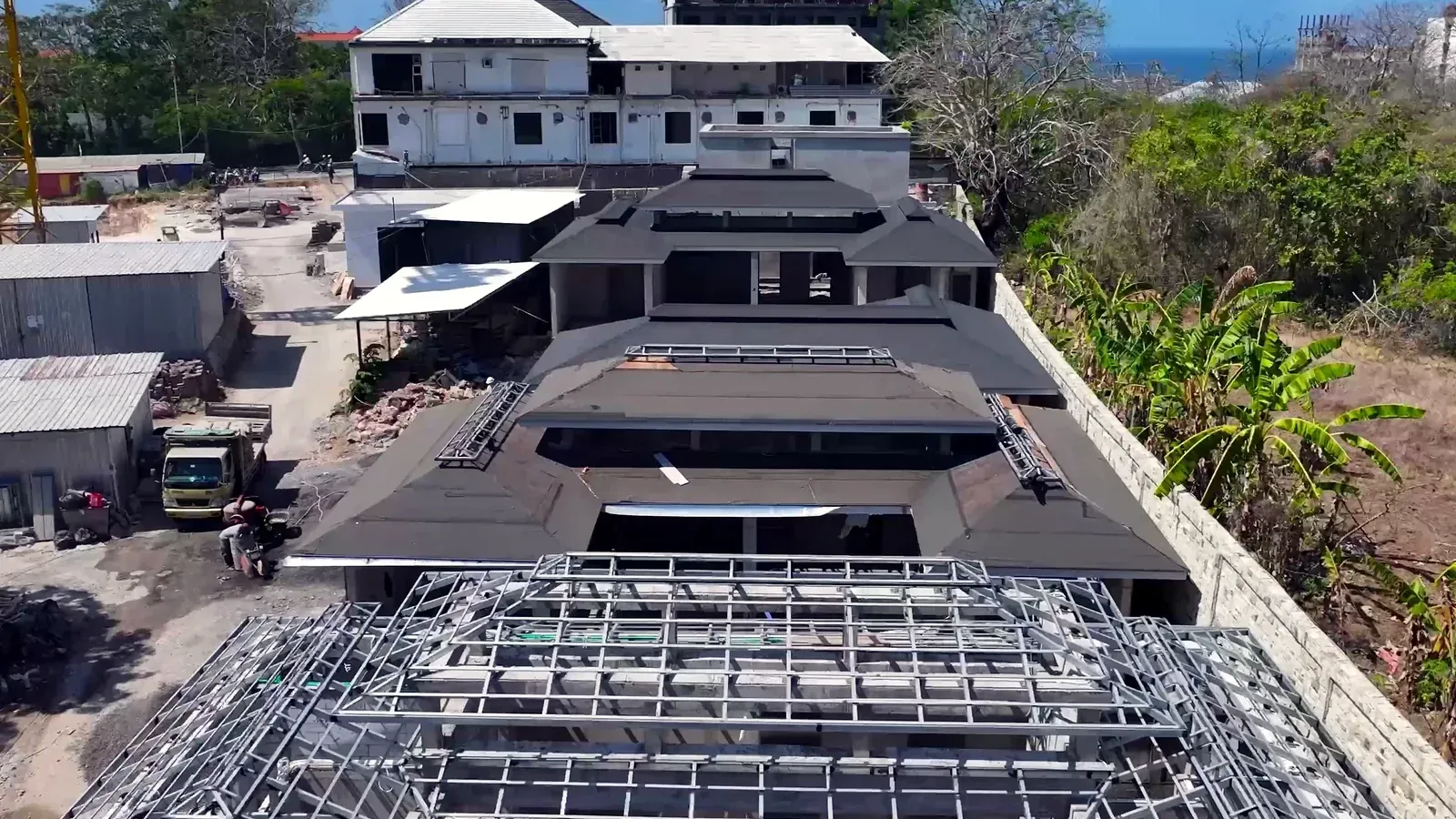
Villa waterproofing in Bali is judged by evidence, not by the brochure. Almost every waterproofing layer in a villa is covered within days or weeks of being laid: below-grade membranes disappear under backfill, bathroom and terrace membranes under screed and tile, roof details under coverings, the pool shell under its finish. If you buy off-plan, the only way to know the work was done properly is to ask for dated records from the moment each layer was still visible, and to read what the warranty says in writing. This article is the request list.
Why is waterproofing the part of a Bali villa you cannot inspect later?
Because it is buried. A buyer can walk a finished villa and judge the joinery, the stone and the light, but not the membrane under the shower tray or behind the retaining wall. Bali also tests that membrane hard. The BMKG climatology station for Bali recorded 177.5 mm of rain in a single day on 7 July 2023, in what is usually the drier half of the year, and its Denpasar geophysics station measured 287.2 mm for March 2024 against a 25-year March average of 224.2 mm. Water that arrives in bursts like that finds every gap in a terrace, roof or wall.
What happens to a building when that water gets in, from damp and mould to corroding reinforcement, is covered in our hub article on what a tropical climate does to buildings. Here we stay with one practical question: what proof should you ask the developer for, and when does it exist?
Below grade: what to ask for before the backfill goes in
Foundations, retaining walls, basements, plant rooms and underground water tanks sit against wet soil for the life of the building. Their waterproofing is usually a membrane or coating applied to the structure, then covered with a protection layer, then backfilled. After backfill, nobody sees it again unless something fails and the ground is dug up.
Where building codes require full below-grade waterproofing, they treat this stage the same way. Guidance on the International Residential Code foundation waterproofing provisions (required in the US on sites with a high water table or hydrostatic pressure) describes an inspection before backfill that checks continuous coverage, laps and seams, sealed penetrations, and a protection board over the membrane so stones and compaction do not tear it. Indonesia is not on that code, but the logic travels: the evidence has to be captured before the soil goes back.
- Dated photos of the membrane on footings, walls and underground structures, including corners, joints and pipe penetrations.
- Photos of the protection layer over the membrane, taken before backfill.
- The name of the waterproofing system used, so you can read its data sheet.
- Who signed off the stage, and on what date.
This is the stage two current HQC sites are at. The August 2026 report for Satori Nusa Dua records the groundwater tank and the electrical switchboard room as finished, with waterproofing of the underground structures in progress. At Aravita, the foundation footings of the first villas are poured and the below-grade waterproofing comes next. Dated reports from both sites are on our construction page.
Bathrooms, showers and terraces: the flood test before tiling
Wet areas are where many of the leaks a buyer will actually notice begin: a shower that stains the ceiling below, a terrace that leaks into the living room. The membrane under the tile is thin, and its weak points are the drain connection, the corners and the upstand at the wall. A flood test checks all of them in the only way that matters, with standing water.
The method is simple. The drain is plugged, the cured membrane is flooded, the water level is marked, and the space below is checked for leaks. LATICRETE's flood testing procedure, based on the ASTM D5957 standard for flood testing horizontal waterproofing, calls for 25 to 100 mm of water held for 24 to 72 hours before any materials go over the membrane, and covers shower pans, patios and decks. ARDEX Australia's technical bulletin sets a minimum of 24 hours and says tiling should follow only once no leaks have been found. If a test fails, the membrane is repaired and the test is run again.
For a buyer, the useful questions are short. Which wet areas and terraces were flood tested? For how long? Is there a photo of the water level at the start and at the end, with dates? A developer who runs these tests will have the record. A developer who does not will talk about the quality of the tile.
Roofs and flat roof terraces: the details where leaks start
Bali villas often combine pitched roofs with flat roof terraces, rooftop lounges and planters. Roof leaks usually start at the details rather than in the open field of the roof: the outlet where water leaves a flat roof, the upstand where the roof meets a wall, pipe and cable penetrations, and the edges of skylights. These are also the points most easily rushed when the roofer and the plumber work to different schedules.
- Photos of each roof drain and outlet before the covering or tiles go on.
- Photos of upstands at walls and parapets, showing the membrane turned up and finished.
- For flat roofs and roof terraces, the same flood test record as for a bathroom: a flat roof is a horizontal waterproofing installation.
- How overflow is handled if a drain blocks during a heavy downpour.
The pool shell: test before finish, warranty in writing
A private pool is a concrete tank holding water permanently, often on or beside a living space. If the shell leaks, the water goes into the structure and the ground around it, and the repair means draining the pool and opening the finish. Two pieces of evidence matter here.
The first is a water test of the pool's waterproofing and its penetrations before the tile or other finish is applied. The same LATICRETE procedure describes filling pools and water features in stages and holding each level for 24 to 72 hours, so a leak can be traced to the drains, returns, lights or other penetrations at each depth.
The second is the warranty. Some villa warranties cover "the structure" without saying whether the pool is part of it, and a pool is easy to argue out of a structural clause. Ask for the pool shell to be named, ask for the term, and ask what counts as a defect. At HQC the wording is explicit: a 10-year warranty on load-bearing structures and the pool shell, and a 12-month warranty on the interior finishes of all premises. At Satori, Aravita and our other projects, it is the same structural warranty.
Evidence by build stage
Element | When it can still be seen | What to ask for |
|---|---|---|
Foundations and underground structures | After the membrane is applied, before backfill | Dated photos of membrane, joints, penetrations and protection layer; who signed off |
Bathrooms and showers | After the membrane cures, before screed and tile | Flood test record: duration, start and end water level, date |
Terraces and flat roofs | After the membrane cures, before tile or covering | Flood test record plus photos of outlets and upstands |
Pitched roofs | Before the covering closes the details | Photos of flashings, valleys, penetrations and roof-to-wall junctions |
Pool shell | Before the pool finish is applied | Water test record of the waterproofing, stage by stage, including penetrations |
Warranty | Before you sign | Pool shell named, structural term stated, finishes term stated |
What the warranty must say in writing
Indonesian law already sets a frame. Article 65 of Law No. 2 of 2017 on Construction Services makes the construction provider liable for building failure for the planned service life of the construction, up to a maximum of 10 years from final handover where that life is longer, and requires the liability period to be stated in the construction contract. Government Regulation No. 16 of 2021 lists testing as a stage of construction before handover, and a building needs a certificate of functional worthiness (SLF) from the regional government before it can be used. These rules govern the builder and the building. As an off-plan buyer, what protects you directly is the warranty in your own contract.
- Which elements are covered: load-bearing structures, the pool shell, finishes, and anything else listed by name.
- The term for each, and the date it starts, usually handover.
- Who gives the warranty: one named legal entity, not a contractor you never signed with.
- How you report a defect and how long the developer has to respond.
- What happens if the property is let through an operator, and who reports defects then.
For the wider contract checks on an off-plan purchase, including stage payments and delay terms, see our guide to buying off-plan property in Bali.
How HQC documents waterproofing
Seismic and hydro insulation are engineered into every HQC project from the foundation up: the frame is engineered for seismic movement and sealed against groundwater. Sites are inspected two to three times a day, with regular technical supervision and photo and video documentation of key stages, and engineering systems, including water and drainage, are tested by our in-house department as construction progresses. The method is set out on our quality page.
Finished buildings are the other half of the evidence. Black Rock, three villas in Ungasan completed in August 2024, has anti-mould hydro insulation and waterproofing, maintained by HQC's in-house engineering. Any HQC project can be visited by prior appointment, and we would rather a buyer look at a building that has been through Bali's wet seasons than take our word for it.
Frequently asked questions
What is a flood test in villa construction?
A flood test checks a waterproofing membrane before it is covered. The drain is plugged, the area is filled with water to a marked level, typically for at least 24 hours, and the space below is checked for leaks. If the level holds and nothing leaks, tiling can proceed.
Can I check waterproofing on a finished villa?
Only partly. You can look for stains, damp, peeling paint and mould, check terrace falls and drains after rain, and ask for the construction records. The membranes themselves are covered, so on a new villa the dated photos and test records are the main evidence.
Does a structural warranty in Bali cover the pool?
Only if it says so. Some warranties cover "the structure" without naming the pool. At HQC, the 10-year warranty names both load-bearing structures and the pool shell, and interior finishes carry a 12-month warranty.
How long should a flood test last?
It depends on the membrane system. LATICRETE's procedure, based on ASTM D5957, calls for 25 to 100 mm of water held for 24 to 72 hours, and ARDEX Australia sets a minimum of 24 hours. Tiling should follow only once no leaks have been found.
Does Indonesian law set a liability period for construction?
Yes. Article 65 of Law No. 2 of 2017 on Construction Services makes the construction provider liable for building failure for the planned service life, up to 10 years from final handover where that life is longer, and the period must be stated in the construction contract. A buyer's direct protection is still the warranty in their own contract.
When should I ask for waterproofing evidence on an off-plan villa?
Before you sign, ask what records the developer keeps. During the build, ask for them as each stage passes: below grade before backfill, wet areas before tiling, roofs before covering, the pool before finishing. Dated reports for HQC sites are published on the construction page.
Continue reading
Villa Handover Inspection in Bali: A Snagging Checklist
Water in a Bali Villa: Supply, Storage and Filtration
