
Water in a Bali Villa: Supply, Storage and Filtration
Where a Bali villa's water comes from, how it is stored and filtered, what keeps the pool clean, whether the tap water is safe to drink, and the questions to ask a developer or seller before you buy.
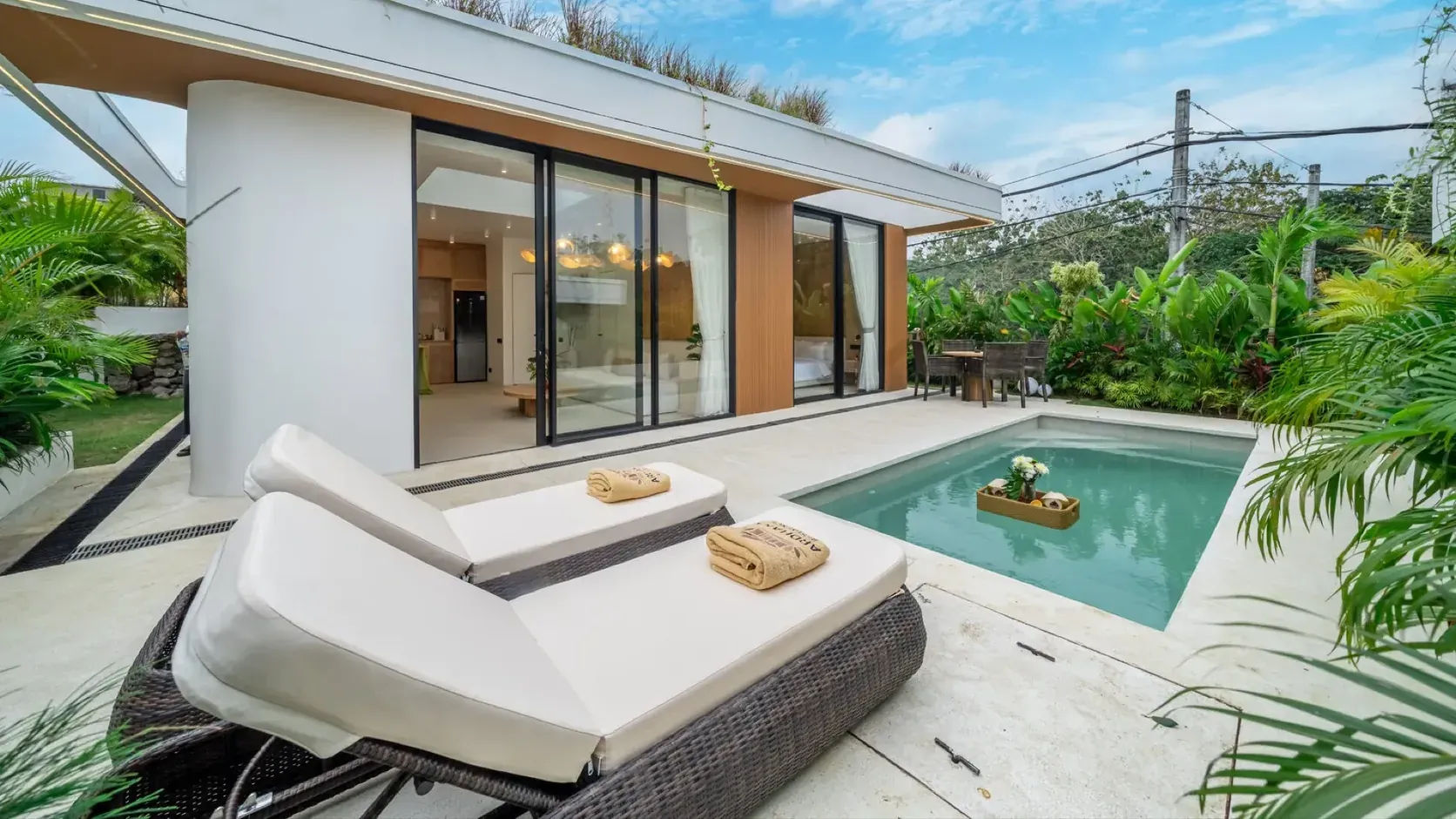
A Bali villa draws its water from one or more of three sources: the regional mains, its own groundwater well, or water brought in by tanker truck. None of them is reliable on its own in every season, particularly in the south of the island, so a well-built villa stores water on site and treats it through multi-stage filtration before it reaches the taps. Tap water in Indonesia is not considered drinkable without treatment, and the pool needs a separate system of filtration, disinfection and pH control. All of this is decided at the design stage, which is why it belongs on a buyer's checklist.
Where does a Bali villa's water come from?
There are three sources, and many villas use more than one. The mix depends on the district, the age of the local network and how the developer engineered the site.
Mains water from the regional utility
Piped water in Bali is supplied by regency-owned utilities, still widely called PDAM. In Badung regency, which covers Kuta, Jimbaran, Nusa Dua, Ungasan and Uluwatu, the utility is Perumda Air Minum Tirta Mangutama. Its reach is still growing: at a regency council working meeting in April 2026, service coverage was reported at a little under two thirds of the regency, with a stated target well above that (Bali Bercerita). Mains water arrives treated at the plant, but by the time it reaches a villa it has travelled through kilometres of pipe and, usually, a storage tank.
Groundwater from a well
Many villas and hotels draw groundwater from a drilled well. Research on Bali's water balance has long pointed to this: a study in the Indonesian Journal of Limnology found that between 1988 and 2013 piped supply covered on average only a little over a quarter of the tourism sector's water demand, yet the sector kept an undisrupted supply through the year, which the authors read as reliance on alternative local sources such as groundwater. Well water quality depends on depth, geology and nearby land use. Over-pumping can also draw seawater into coastal aquifers, a risk Indonesia's energy and mineral resources ministry cites when it explains why large groundwater use is regulated, so a well that tested well years ago should be tested again.
Tanker water
Tanker trucks fill on-site tanks where there is no mains connection, where the well is inadequate, or when the mains fail. It is a practical stopgap, but its source and handling are outside your control, and a villa that depends on it permanently carries that question every day.
Why the south of Bali needs particular attention
Our guide to Nusa Dua, Ungasan and Uluwatu noted that parts of the Bukit plateau historically relied on trucked-in water. The plateau is porous limestone with no natural surface water, so its mains supply arrives by pipe from treatment plants further north. That makes it sensitive to any single failure along the way.
Recent events show how this works in practice. In early September 2026 the utility reported that falling raw water levels at the Muara reservoir in the dry season had reduced production, with the effect felt mainly in south Badung (Bali Wake News). Later that month, the utility said south Badung depends heavily on its service and has few alternative sources, and it put tanker trucks on standby (Bali Prawara). On 26 September a short circuit in an 800 kW pump motor at the Estuary treatment plant cut supply to areas including Jimbaran, Kutuh, Ungasan, Pecatu, Sawangan and Bualu, and the utility supplied free water by tanker while the motor was replaced (NusaBali).
The network is being reinforced. The utility has described new reservoirs and new pipe sections serving the south, including a line from the Wellsite reservoir to Ungasan, and said that the existing transmission pipes, not only production, limit how much water can reach south Badung (Bali Post, April 2025). Until that work settles, a villa in the south should be designed to ride through an interruption of several days without its owner or guests noticing.
Source | Strength | What to watch for | What to ask for |
|---|---|---|---|
Mains (PDAM / Perumda) | Treated at the plant, no pumping from your own land | Interruptions in the dry season and during repairs; variable pressure | Connection confirmed in writing; on-site storage sized for outages |
Own well | Independent of the network | Quality varies with depth and location; coastal wells can turn brackish | A recent laboratory test of the well water; the approval or licence status |
Tanker delivery | Fills tanks when other sources fail | Unknown source and handling; ongoing running cost | Whether delivery is a backup or the everyday supply |
Is tap water safe to drink in a Bali villa?
Not without treatment. The U.S. State Department advises that tap water in Indonesia is not potable and should not be consumed, and the CDC recommends bottled or disinfected water for drinking and brushing teeth wherever tap water might be contaminated. Indonesian regulation itself separates the two uses. Minister of Health Regulation No. 2 of 2023 sets distinct environmental health standards for drinking water, for water used for hygiene and sanitation, and for swimming pool water.
In practice, a villa treats its whole supply to a good standard for showers, laundry and cleaning, and provides drinking water separately: through a dedicated drinking-water filter at the kitchen tap or through sealed bottled water. Ask which of the two a villa has, and never assume that filtered water at the shower is drinkable.
Storage: tanks, pumps and pressure
Whatever the source, the water usually passes through storage before it reaches the taps. Ground-level or buried tanks hold a reserve against interruptions; a pump and pressure vessel deliver steady pressure to the bathrooms. A good tank is sealed against light, insects and runoff, sized for the occupancy the villa is built for through the interruptions the district actually sees, and accessible for cleaning, because sediment settles in every tank.
What multi-stage filtration actually means
Multi-stage filtration treats different problems in sequence rather than relying on one filter to do everything. A typical sequence removes sand, rust and other particles first, then uses activated carbon to reduce chlorine, odours and some organic compounds, and adds a disinfection step, often ultraviolet light, to deal with bacteria and viruses. Where the water is hard, a softening stage protects heaters, fittings and glass from scale. The right combination depends on a laboratory test of the actual source water, which is why the same filter set is not correct for every site.
Filtration is also a maintenance commitment. Cartridges clog, media need replacing and UV lamps lose strength. Ask who services the system, on what schedule, and whether the service log is available. A filter that has not been serviced can be worse than no filter at all, because it collects what it removes.
Pool water treatment
A pool is a water system of its own. Water circulates through a pump and filter, a disinfectant keeps a residual in the water to deal with what bathers bring in, and the pH is held in a range where the disinfectant works and the water is comfortable. The World Health Organization's guidelines for swimming pools and similar environments state that a conventional public or semi-public pool with good hydraulics and filtration, operating within its design bathing load, should achieve adequate routine disinfection with a free chlorine level of 1 mg/l, that pH should be kept between 7.2 and 7.8 for chlorine disinfectants, and suggest that the disinfectant residual in domestic pools be checked before use.
For a buyer, the questions are practical: what filtration and disinfection the pool uses, how the pool shell is sealed against leaks, how often the water is tested, and who does it.
How HQC approaches water
We treat water as part of the building, not an afterthought. At Dzen Green Fields in Ubud, each villa has its own filtered water supply with multi-stage water filtration, installed by our own teams together with the frame, insulation and MEP. At Black Rock in Ungasan, multi-stage water filtration was already installed when the villas were completed in 2024, and every villa has a private pool with quality water filtration. At Ardhana, also in Ungasan, the villas have filtered pools and the project is built with multi-stage water filtration.
At Satori in Nusa Dua, which is under construction, the August 2026 site report records the groundwater tank as finished, alongside the electrical switchboard room, with waterproofing of the underground structures in progress. Across our sites, engineering systems including water and drainage are tested by our in-house department at every stage of construction, and the pool shell is covered by our 10-year warranty on load-bearing structures. More on how we build and test is on our quality page.
Questions to ask a developer or seller
- Which sources supply the villa: mains, well, tanker deliveries, or a combination? Which is the everyday source and which is the backup?
- If there is a well, is there a recent laboratory test of the water, and what approval or licence covers it?
- How much water is stored on site, and how many days of normal use does that cover if the main source stops?
- What filtration stages are installed for the whole house, and what is the separate arrangement for drinking water?
- Who services the filters and pumps, how often, and can you see the service log?
- How is the pool filtered and disinfected, how often is the water tested, and is the pool shell covered by a structural guarantee?
- Were the water and drainage lines tested before walls and floors closed over them, and are the records available?
Frequently asked questions
Can you drink the tap water in a Bali villa?
Not unless the villa has a dedicated drinking-water treatment system. Tap water in Indonesia is not considered potable, so drink sealed bottled water or water from a purpose-built drinking-water filter, and use it for brushing teeth as well.
Where does a Bali villa get its water?
From the regional mains (PDAM, now Perumda), a private groundwater well, tanker deliveries, or a combination. A well-built villa stores water on site so that an interruption in one source does not reach the taps.
Is water supply a problem in Uluwatu, Ungasan and Nusa Dua?
It can be. The south of Badung depends on piped supply from treatment plants to the north. In September 2026 the dry season reduced production, and a pump failure on 26 September interrupted supply to areas including Jimbaran, Ungasan, Pecatu and the Nusa Dua villages of Bualu and Sawangan. On-site storage and a backup source matter more here than elsewhere.
Do I need a permit for a well at my villa in Bali?
For household use under 100 m³ a month for basic daily needs, no groundwater use approval is required under the 2024 rules. Larger household use needs an approval, and a well that supports a business, such as a villa let commercially, generally needs a groundwater business licence. Confirm the status for the specific property.
What is multi-stage water filtration?
A sequence of treatment steps rather than one filter: sediment filtration for sand and rust, activated carbon for chlorine and odours, and a disinfection step, often ultraviolet light, for bacteria and viruses, with softening added where the water is hard. The right combination depends on a laboratory test of the source water.
How is a private pool kept clean in Bali?
Through continuous circulation and filtration, a disinfectant residual, usually chlorine-based, and a pH held between 7.2 and 7.8, with regular testing. Heavy rain and heat make testing more important, not less.
See the water systems for yourself
Water is one of the systems you cannot judge from photographs. Talk to the HQC team and ask how a specific villa is supplied, stored and filtered, or arrange a visit to see the systems on a completed project.
Continue reading
Villa Handover Inspection in Bali: A Snagging Checklist

Turnkey Villas in Bali: What Fully Furnished Covers
