Buying Property in Ubud: Freehold, Rice Fields and Rules
What an inland, rice-terrace address in Ubud changes compared with the coast, how to check protected farmland and zoning, and what "freehold" in an Ubud villa listing means for a foreign buyer.
In brief: Ubud is a good place to buy property if you want a green, inland base with a slower daily rhythm and plan to use the home yourself. The two checks that matter most here are different from the coast. First, the land: much of Ubud is working rice terraces, some of it protected by law, so the plot's zoning decides what can legally stand on it. Second, the title: "freehold" in an Ubud listing usually means Hak Milik, a right Indonesian law reserves for Indonesian citizens, so a foreign buyer needs a lawful holding structure confirmed by an Indonesian lawyer.
Is Ubud a good place to buy property?
It depends on how you will use the home. Ubud sits inland in Gianyar regency, among the rice terraces, river valleys and temples that made it known as the cultural centre of Bali. Our guide to the best areas to buy property in Bali places Ubud alongside Canggu, the Bukit Peninsula, Nusa Dua and Sanur. This article goes one level deeper: what changes when the address is a rice-terrace plot rather than a coastal street, and what to verify before you sign.
Buyers who are happy in Ubud usually want three things: green views that are not going to be built out next year, a quieter base for long stays, and easy access to the town's yoga, wellness, food and schools. Buyers who are less happy usually expected a beach lifestyle or a rental business that runs itself. Being clear about which buyer you are saves months.
What changes inland compared with the coast?
Ubud (inland, rice terraces) | Coastal south (Bukit, Nusa Dua, Canggu) | |
|---|---|---|
Daily rhythm | Early mornings, quiet evenings, life around wellness, food and culture | Beach, surf and nightlife set the pace |
Access | The beach and the southern business districts are a drive, not a walk | Beaches and beach clubs close by; traffic varies by district |
Land | Much of it is, or was, irrigated rice field; protected farmland is common | More land already zoned for tourism and housing, with its own checks |
Privacy and outlook | Low-rise, green outlooks; the view depends on what is protected around you | Ocean or garden outlooks; density varies widely |
Owner use | Strong fit for long personal stays and remote work | Strong fit for holidays and operator-managed rental |
The table is a starting point, not a verdict. Inside Ubud the differences between villages are large: a plot five minutes from the town centre lives very differently from one at the end of a narrow village lane. Visit at the hours you would actually use the house, and drive the route you would actually take.
Can you build a villa on a rice field in Ubud?
Sometimes, and sometimes never. The answer sits in the zoning of that exact plot, not in the listing. Rice terraces in Bali are more than scenery: the irrigation system behind them, the subak, is part of the Cultural Landscape of Bali Province World Heritage site, which UNESCO describes as five rice-terrace landscapes and their water temples covering 19,500 hectares, including the subak landscape of the Pakerisan watershed in Gianyar.
The legal protection comes from Law 41 of 2009 on the Protection of Sustainable Food Agricultural Land. Article 44 says land designated as sustainable food agricultural land, known as LP2B, is protected and may not be converted, except for public interest under strict conditions. Article 50 says any permit that results in converting LP2B is void, and Article 72 sets criminal penalties, including prison, for converting it.
In Ubud this is applied plot by plot. The regency's spatial plan and the detailed spatial plan for Ubud district (Perbup Gianyar 7 of 2023) mark which land is tourism zone, which is housing and which is protected food-crop land. In July 2025, Bisnis Bali reported that Gianyar's public order agency sealed a villa in Sayan, Ubud, built without permits: three of its buildings stood in the LP2B zone, and two others, in the tourism zone, were too close to a temple. The LP2B land must be returned to farming. In January 2025, Gianyar permanently closed an unlicensed tourism complex in Ubud and Bali police named a suspect for building a villa, spa and livestock farm on protected rice land, as Bali Expat reported, citing Voice of Indonesia.
The direction of travel is clear. After the floods of September 2025, Governor Wayan Koster announced plans for a regional regulation to prohibit villas, hotels and restaurants on productive farmland, The Jakarta Post reported. In 2026 the province adopted Bali Provincial Regulation 4 of 2026 on controlling the conversion of productive land and prohibiting the transfer of land ownership through nominees. In October 2025, the Regent of Gianyar told the regional parliament that business licences would not be issued where LP2B had been converted for tourism, and that zoning and spatial approval are verified through OSS, detikBali reported.
For a buyer, this cuts both ways. A villa on correctly zoned land, with its building approval in place, now sits next to fields that are hard to build on, which protects the outlook. A villa on the wrong side of the zoning line can be sealed, and no contract fixes that.
Can foreigners buy freehold in Ubud?
Not in their own name, in the strict legal sense. In Bali listings, "freehold" almost always means Hak Milik, the strongest land right in Indonesia. Article 21 of the Basic Agrarian Law (Law 5 of 1960) says only Indonesian citizens can hold Hak Milik, and Article 26 makes any transfer intended to pass it, directly or indirectly, to a foreigner void, with the land falling to the State. That is why "freehold for foreigners" in an advertisement should always prompt the question: held by whom, under which title?
The lawful routes a foreign buyer's lawyer will usually compare are:
- Hak Pakai (right to use). Under Government Regulation 18 of 2021, a foreign individual with valid immigration documents may own a house on Hak Pakai land, subject to conditions such as a regional minimum value set by the land ministry. Land held as Hak Milik can carry a Hak Pakai granted by the owner, registered at the land office.
- A company structure (PT PMA). A foreign-owned Indonesian company can hold building rights, but it must run a real, licensed business, which brings its own zoning, licensing and reporting duties.
- Leasehold. A registered long lease from the owner of a Hak Milik plot. Our leasehold vs freehold guide explains terms, extensions and resale.
What is not a lawful route is a nominee: an Indonesian citizen holding the Hak Milik on paper while side agreements give the foreigner control. Beyond being void under the Basic Agrarian Law, transferring land ownership through a nominee is now prohibited explicitly by Bali's 2026 provincial regulation. If a seller proposes one, walk away.
A completed example: Dzen Green Fields
We use our own project as a reference point because it can be visited, not because it is the only way to buy in Ubud. Dzen Green Fields is a boutique complex of ten barnhouse villas among working rice terraces, four minutes from central Ubud. Construction was completed in May 2025, and the villas are lived in. The original release sold out; completed villas can become available through resale.

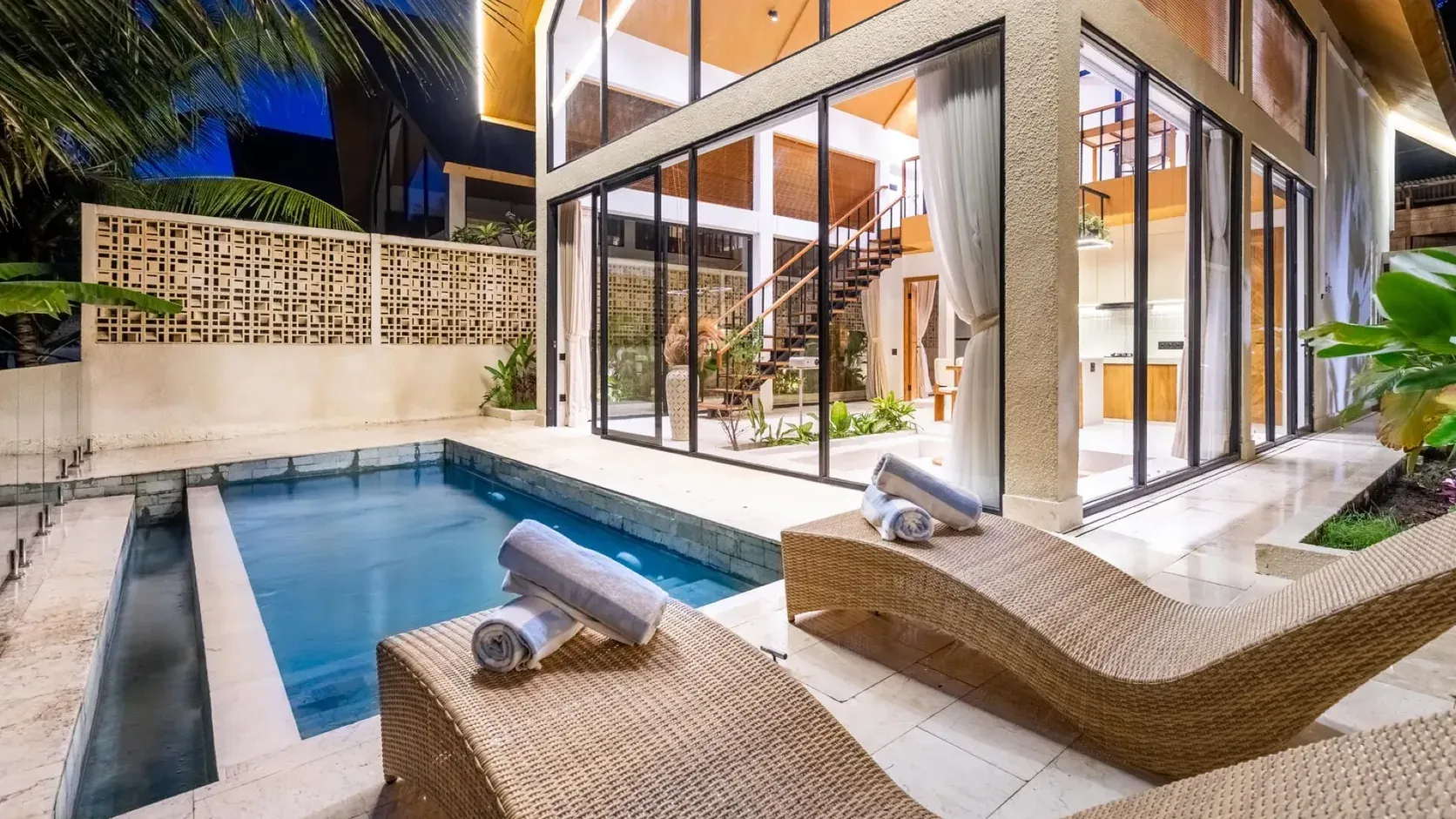
What it shows about inland living is practical. Each villa has a 15 m² infinity pool oriented to the sunrise over the fields, on a private plot of about 1.7 to 1.9 are (170 to 190 m²). The built areas fall into three groups: 108 m² on one storey, and 117 m² or 133 m² on two storeys. Every villa was completed turnkey, with furniture and appliances included, and each bedroom has its own workspace, which matters to owners who stay for months and work remotely.
Inland plots raise their own engineering questions, especially about water. At Dzen, each villa has its own filtered supply through a multi-stage filtration system. The frame, seismic and hydro insulation, finishes, joinery, MEP and filtration were all installed by HQC's own teams, and our co-founder Dmitry Barannik personally led the project.
Dzen is held freehold. Consistent with everything above, the holding structure for a foreign buyer is confirmed with a qualified Indonesian lawyer case by case. If you look at a resale villa there, or anywhere in Ubud, ask for the title, zoning and permit documents and have your own lawyer read them.
How to shortlist Ubud homes for sale
- Decide the use first: personal stays, long-term letting or short-stay rental. Each needs different zoning and licences.
- Walk the plot and its neighbours, and ask which surrounding fields are protected. That decides whether your view will last.
- Check access in the rainy season: the lane, drainage and the slope of the plot.
- Ask who supplies water and power, and how the water is treated.
- Inspect finished work wherever you can. A completed villa shows how a builder handles humidity, drainage and joinery; a render does not.
- Put the title, zoning, permits and holding structure in front of your lawyer before any deposit.
For the wider case for the island, read why investors choose Bali.
Frequently asked questions
Is Ubud a good place to buy property?
Yes, for buyers who want a green inland base, value privacy and a calmer rhythm, and plan to use the home themselves. It suits short-stay rental only where the zoning and licences allow it, so check that before treating a villa as a rental business.
Can foreigners buy freehold in Ubud?
Not directly. Hak Milik, the Indonesian freehold title, is reserved for Indonesian citizens. Foreigners use Hak Pakai, a company structure or a leasehold, and the right structure for a "freehold" villa is confirmed by an Indonesian lawyer. Nominee arrangements are void and prohibited.
Can I build a villa on rice fields in Ubud?
Only where the plot's zoning allows it. Land designated as LP2B is protected under Law 41 of 2009 and cannot be converted; permits that convert it are void. Gianyar regency has sealed villas built on protected rice land in Ubud.
What should I check before buying a villa in Ubud?
The land certificate at BPN, the zoning of the exact plot, whether any of it is protected farmland, the PBG building approval and SLF certificate, the licences for any rental use, and the holding structure for a foreign owner.
How is living in Ubud different from the coast?
Ubud is inland: the beach and the southern business districts are a drive, not a walk, and daily life runs around wellness, food and culture rather than surf and nightlife. It suits long personal stays and remote work; the coast suits holidays and operator-managed rental.
Is Dzen Green Fields still for sale?
The original release sold out. Completed villas can become available through resale. Contact the HQC team to ask about resale availability.
Continue reading
Living in Bali Part-Time: An Owner's Practical Guide
Melasti Beach Villas: Buying on the Ungasan Hills