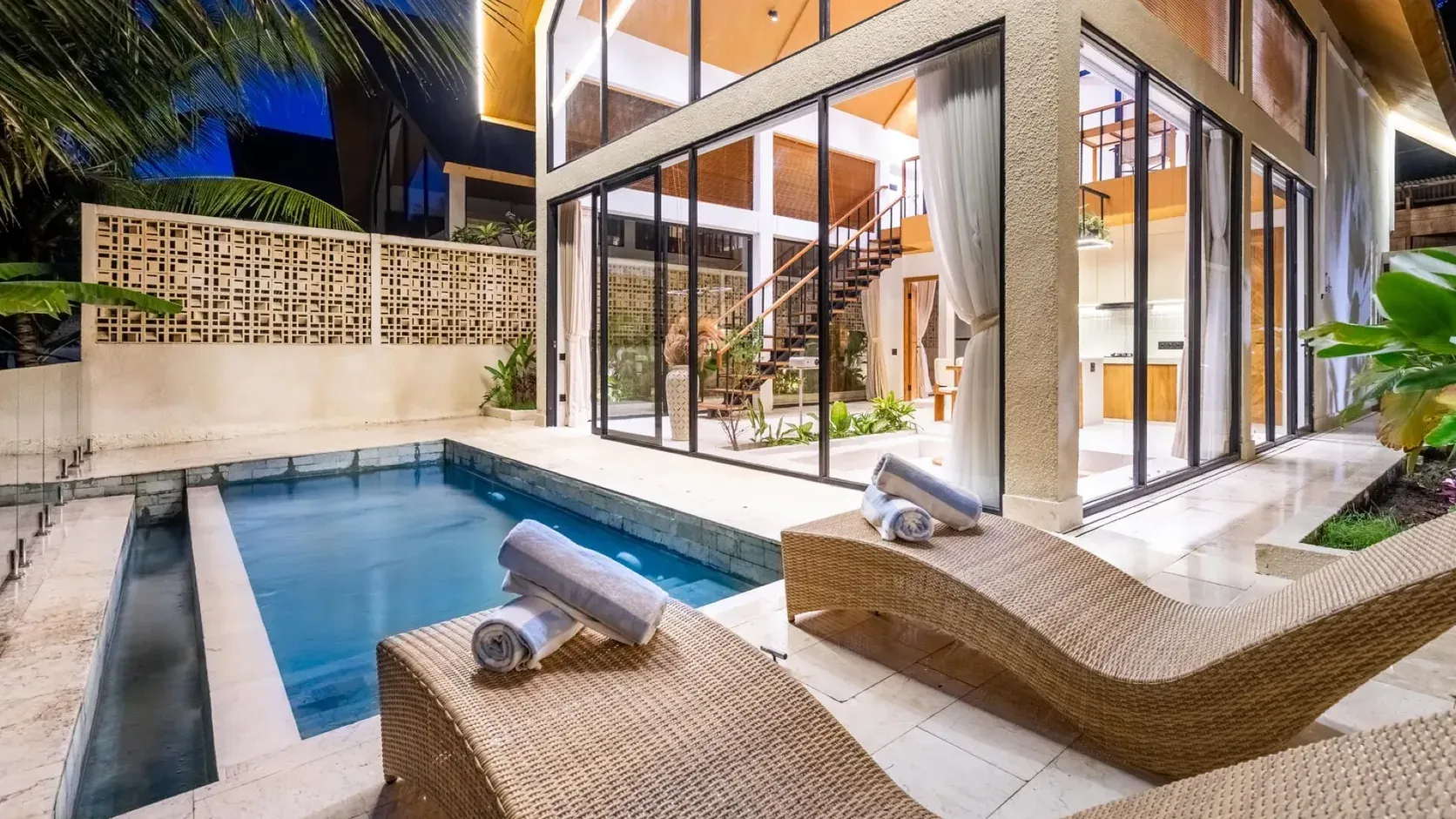
Living in Bali Part-Time: An Owner's Practical Guide
What part-time life in Bali looks like when the home is rented out while you are away: long-stay community or hotel-run residence, how owner-use nights work, who handles repairs, and how to buy and own remotely.

In brief: Living in Bali part-time works best when the home is set up to run without you. The first decision is the format: a long-stay community, where tenants stay a month or more, or a hotel-run residence, where an operator rents the unit by the night. That choice decides how often you can stay, who the neighbours are when you arrive, and who answers the phone when something breaks. Visas are a separate question, covered in our guide to the retirement, Second Home and Golden visas.
What does living in Bali part-time actually look like?
For many owners, it means a few weeks to a few months on the island each year, usually timed around winter at home, school holidays or a work break. For the rest of the year the home is occupied by someone else, either tenants on stays of a month or longer, or hotel guests booked by the night. The owner wants three things at once: a home that feels ready the day they land, a property that earns its keep while they are away, and no surprises in between.
Those three goals pull in different directions. A home that is always ready for you is a home that is empty when you are not there. A home that is rented every night is a home you have to book like a guest. The practical answer is to pick the operating model first and the house second.
Long-stay community or hotel-run residence: which fits a part-time owner?
Both formats suit part-time owners, but they suit different ones. The table sets out the differences that matter once you are living in Bali for part of the year rather than visiting once.
Long-stay community | Hotel-run residence | |
|---|---|---|
Who stays when you are away | Residents on stays of a month or more | Hotel guests on short stays, booked through the operator |
What it feels like when you arrive | A neighbourhood: the same faces at the gym, the café and the school run | A hotel: reception, housekeeping and services, with guests changing every few days |
How your own stays work | Set by the community rules; check the terms for your unit | Usually a fixed number of owner nights a year, booked in advance |
Who runs it | A management company for the community | A hotel operator or brand, sometimes with the developer running daily operations |
Who it suits | Owners who want a second life on the island, often with family | Owners who want a hands-off asset and stay for shorter, planned visits |
The long-stay community
A long-stay community is built for people who live there, not for a weekend. Aravita, HQC's gated villa community in Sawangan, is designed for conscious long-stay living from a month upward. A sunset lounge, a kids club, a spa, a yoga shala, two restaurants, a community centre and a gym are all reachable on foot inside the community. Its land is zoned for long-term residential use, so the people next door are residents rather than weekend holidaymakers, and it is run by HQC's own management company.
For a part-time owner, that changes the texture of each visit. You come back to a place with routines already in it: a class you can join, a restaurant where you are known, children who can walk to the kids club. Between your visits the villa is lived in, which is also good for the building itself. A home that is aired, cooled and used every day tends to age better in the tropics than one that is locked up for months.
The hotel-run residence
A hotel-run residence is a unit inside a hotel that an operator rents out by the night. Bloom, the HQC hotel in Ungasan that is fully managed by Radisson, is a clear example of the format: it is short-stay only and adults-only, so the residences work as hospitality inventory rather than a home to live in. That is the point for some owners. The operator handles guests, housekeeping, reviews and maintenance; the owner stays as a guest on agreed dates and leaves the rest to the hotel.
The trade-off is control. You do not keep your own things in a hotel room, and you book your stay around the hotel's calendar. If you want a home that holds your books and your surfboard, a long-stay format fits better. For a wider comparison of villas, apartments and hotel rooms as assets, see villa, apartment or hotel room in Bali.
How do owner-use nights work?
Owner use is the most misunderstood clause in a part-time owner's contract. In a rented property, every night you stay is a night that is not available to guests, so the agreement sets how many nights you can take and on what terms.
At HQC the terms are individual to each property, but the general rule is that the owner may stay in their unit for up to 30 days per year and covers all costs for the period of the stay. Separate terms apply at Aravita. The exact clause is in your management agreement, and our FAQ sets out the general rule.
Before you sign, ask four questions about owner use:
- How many nights a year can I stay, and do unused nights carry over?
- How far in advance must I book, and can I take peak dates such as Christmas and New Year?
- Which costs do I cover during my stay: cleaning, utilities, breakfast, services?
- Can family or friends use my nights when I am not there, and on what terms?
Who handles repairs while you are away?
This is the question that decides whether part-time ownership feels relaxing or stressful. In Bali the climate works on a building every day: heavy rain in the wet season, humidity, salt air near the coast and strong sun. The timing of the seasons also shifts from year to year. In its November 2025 update, Indonesia's meteorological agency BMKG pushed back its forecast for the start of the 2025/2026 rainy season in Bali and Nusa Tenggara. An owner living abroad cannot react to that in real time.
At HQC, after handover, repairs are handled by the management company, so there is no need for the owner to contact anyone. The exact procedure depends on the complex, but the approach is the same: the property is in rental operation, its internal condition is monitored in full, and repairs are carried out by the team. In addition, each property's financial model includes an allocation for depreciation, which covers ongoing repairs and the planned replacement of furniture in the future.
Whoever builds or manages your home, ask how they handle three things: routine maintenance on a schedule, urgent repairs while you are abroad, and how they report to you afterwards. For the licences and management models behind a rented villa, read villa management and rental licences in Bali.
Can you buy and own a Bali home remotely?
Yes, and many owners do. At HQC, about four in five transactions are completed entirely remotely; the rest involve an in-person meeting. Being in Bali is not a requirement, but it is always an option: on-site viewings can be arranged any day, by appointment, and many buyers combine one visit with remote paperwork.
The legal basis for signing at a distance exists. Under Indonesia's Law 11 of 2008 on Electronic Information and Transactions, an electronic signature has legal force when it meets set conditions, including that the signing data is linked only to the signer and that later changes can be detected. The second amendment to that law, Law 1 of 2024, requires high-risk electronic transactions to use electronic signatures secured by an electronic certificate. In practice, ask which documents will be signed electronically, which need a notary, and whether any step needs a power of attorney.
Remote ownership after the purchase depends on reporting. A part-time owner should expect regular updates on the condition of the home, the bookings and the costs, without having to ask. If a manager cannot describe how they report, that tells you how the relationship will feel from abroad.
What rules still apply to a part-time owner?
Two sets of rules follow a rented home whether you are on the island or not.
The first is guest registration. Under Article 72 of Indonesia's Immigration Law (Law 6 of 2011, as amended by Law 63 of 2024), anyone who accommodates foreigners must provide their data to Immigration when an official asks. The Directorate General of Immigration runs the APOA app for this: the owner or manager of the accommodation uploads the guest's passport page at check-in and records the check-out. Failing to comply can lead to up to three months' detention or a fine. In a managed property this is the operator's job, but it is worth confirming that it is done.
The second is licensing for short-term rental. Indonesia's Ministry of Tourism is linking online booking platforms to the national OSS licensing database. Platforms will ask hosts for their business registration (NIB), business classification (KBLI) and business activity (NKU) numbers, and the minister said in May 2026 that automatic, API-based licence checks are targeted for June 2027, after which accommodation without a valid NIB should no longer be listed. A part-time owner who plans to rent the home should make sure it is licensed under the right operator before the first booking.
A practical year for a part-time owner
- Choose the format first: long-stay community if you want a second life on the island, hotel-run residence if you want a hands-off asset.
- Read the owner-use clause line by line and book your nights early, especially around holidays and Nyepi.
- Agree how repairs, maintenance and reporting work while you are away, in writing.
- Confirm the licences and guest registration are handled by the operator.
- Settle your visa route separately, before you plan a long stay.
- Visit at least once, even if you buy remotely, to see finished work rather than renders.
Frequently asked questions
Can I live in my Bali villa part of the year and rent it out the rest?
Yes. This is a common way to use a Bali home part-time. In a hotel-run property the agreement sets your owner nights, and in HQC properties the general rule is up to 30 days a year, with the owner covering costs of the stay. A long-stay community such as Aravita has separate terms.
Who looks after my home in Bali when I am abroad?
In a managed property, the management company. At HQC it monitors the condition of the home, carries out repairs, and each property budgets a depreciation allocation for repairs and future furniture replacement.
Do I need to be in Bali to buy?
No. About four in five HQC transactions are completed entirely remotely. Electronic signatures are recognised under Indonesian law when they meet set conditions, and on-site viewings can be arranged any day by appointment if you prefer to see the home first.
Does owning a home in Bali give me the right to stay there?
No. Property and residence are separate questions. Read our visa guide for property owners for the options.
When is Bali airport closed for Nyepi?
Once a year, on Nyepi, the Day of Silence. In 2026 regular commercial flights at Ngurah Rai were suspended for 24 hours, from 06:00 on 19 March to 06:00 on 20 March; only emergency and specially approved flights could operate. Check the date before you book flights or owner nights around it.
Is a long-stay community or a hotel better for a family?
For a family that spends weeks at a time on the island, a long-stay community usually fits better: residents rather than short-stay guests, and amenities such as a kids club, a gym and restaurants within walking distance. Bloom, for example, is adults-only.
More answers on ownership, management and owner use are in the HQC FAQ, or ask the team to arrange a viewing.
Continue reading

Melasti Beach Villas: Buying on the Ungasan Hills
Nusa Dua Property: Living on the Sawangan Coast