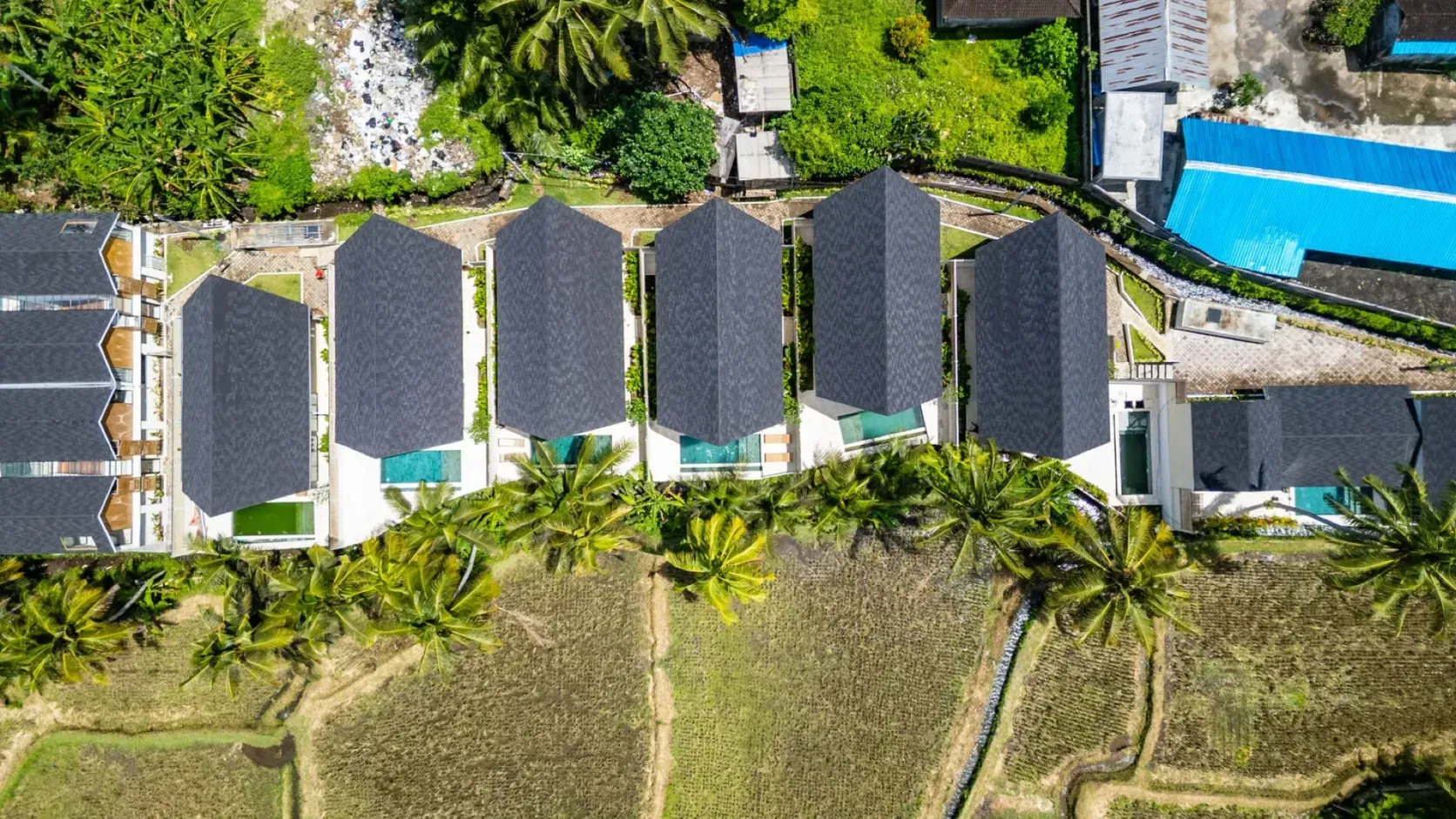
How to Check a Bali Property Developer Before You Buy
Vet the company before the plot: the legal entity that signs, finished buildings you can walk through, dated site reports, who actually builds, delay and defect terms in the contract, and who else has checked the developer.

To check a Bali property developer, verify the company rather than the brochure. Confirm the legal entity in Indonesia's official registries, visit projects it has already finished and that people already live in, ask for dated reports from its active sites, and find out who actually builds. Then read two clauses in the contract, the delay penalty and the warranty, and look for third parties who have done their own due diligence on the developer. Most of these checks start with a public registry or a site visit, and a serious developer will help you run them.
Why check the developer and not only the plot?
Most buying guides focus on the property: the land certificate, the zoning, the building approval. Those checks matter, and our Bali property due diligence checklist covers them document by document. But when you buy a villa or a hotel unit before it is finished, the documents describe a promise. Whether the promise becomes a building depends on the company that holds the contract, the team on site and the remedies you have if the schedule slips. In our experience, buyers who ask about the developer as carefully as they ask about the land make calmer decisions.
Indonesian housing rules point the same way. For houses and apartments sold before completion, Government Regulation (PP) No. 12 of 2021 allows a conditional sale agreement (PPJB) for houses and apartments sold with ownership title only once there is certainty over the land ownership, the terms being promised, the building approval (PBG), the availability of infrastructure and a minimum level of construction progress, as Leks&Co summarises. Leasehold villas and hotel units are usually sold under different agreements, but the logic carries over: an off-plan sale should rest on what the developer has already secured, not only on the plot.
Step 1: Is the company real, and is it the one that signs?
Every Indonesian limited company (PT) has a public profile in AHU Online, the Ministry of Law's company registry, where you can search the registered name and request the company's official profile, which sets out its legal status and current officers. A company that runs a business also needs a business identification number (NIB), which the government issues through the Online Single Submission (OSS) system. Speaking in February 2026, Indonesia's Deputy Minister of Investment put it plainly: a company's legal establishment matters, but the key to running a business legally is the NIB.
Then compare three names: the brand on the marketing, the company in the registry and the party that signs your contract. They do not have to be identical, but you should understand how they connect. Ask who signs the leasehold agreement, who signs the construction agreement and who signs the management or operator agreement. If the answer is a chain of separate companies, ask which one carries responsibility for the building and the warranty, and whether that company holds the assets to back it.
At HQC, investors work with one registered legal entity that carries both financial and operational responsibility. As a full-cycle developer, from land and design through construction and furnishing to preparing the property for the operator, the company itself is accountable for construction and the warranties, not a contractor further down the chain.
Step 2: What has the developer finished, and can you walk through it?
Renders and show units prove design skill. Only finished buildings prove the ability to finish. Ask for a list of completed projects with the month construction ended, and then ask to visit at least one that is occupied. On site, look at the details that are hard to fake: how the pools and wet areas have aged after a rainy season, whether walls show damp at the base, how doors and joinery have held up in the humidity, and what the people living or staying there say about repairs.
Be honest about what a track record can and cannot show. HQC was founded in 2023, so our record is short, and we point buyers to the buildings rather than the years. Black Rock in Ungasan has been completed, furnished and operating since August 2024. Dzen Green Fields in Ubud completed construction in May 2025 and is occupied. The Luxury and Fengshui villa quarters of Ardhana Residence completed construction in June 2025 and are occupied while the boutique hotel rises alongside. Any HQC project is open for a visit on any day, by prior appointment. The construction page shows the completed projects on their own photographs.
Step 3: Does the developer publish dated progress from active sites?
For anything still being built, ask for site reports with a date on them. A dated report lets you compare progress with the schedule in your contract, month by month. Undated photo galleries tell you very little, because you cannot tell whether a frame is from last week or last year. Good reports name the stage (foundations, slabs, roofing, finishing), show the same areas over time and mention the permits in place.
HQC publishes dated English-language site reports for its active builds. The September 2026 reports cover Satori, Ardhana, Aravita and Bloom, filmed on our own cameras, and they sit on the construction page next to written summaries of the August 2026 reports. If a report and the schedule disagree, that is a question to ask before you sign, not after.
Step 4: Who actually builds?
Some developers in Bali are mainly marketing and sales companies that hire general contractors. That model can work, but it moves the people who pour the concrete one contract away from you. Ask how many engineers the developer employs directly, who supervises each site day to day, and which work is subcontracted. If a contractor is involved, check that it holds a valid construction business certificate (SBU). Under Law No. 2 of 2017 on Construction Services, every company that carries out construction work must hold an SBU, which states its classification and qualification, and the certificate can be checked by NIB, company name or certificate number in the LPJK database and the SIJK construction data portal of the Ministry of Public Works.
HQC runs an 800+ team on the ground: 100+ staff engineers and managers, plus 700+ people working on company construction sites every day. Design, construction, MEP and an in-house furniture factory of 4,000 m² sit under one roof, so the interiors are fitted out by our own workshop rather than assembled from several suppliers at the end of the build.
Step 5: What does the contract say about delays and defects?
Two clauses tell you more about a developer than any presentation. The first is the delay remedy. A serious contract sets a completion date and a penalty for each day the developer runs past it, with the amount and the calculation written out, not left to negotiation later. The HQC contract works this way: if we breach the completion dates set in the contract, the investor is entitled to a penalty for each day of delay, and the clause states how it is calculated.
The second is the warranty. Indonesian law already places a duty on the builder: under Article 65 of Law No. 2 of 2017, a construction services provider is responsible for building failure for the planned life of the structure, up to a maximum of 10 years from the final handover of the construction work, and the period must be stated in the construction contract. That duty runs to whoever hired the builder. What buyers need is that responsibility written into their own contract, with a named party and a clear scope. HQC gives a 10-year warranty on load-bearing structures and the pool shell, and a 12-month warranty on the interior finishes of all premises.
Step 6: Who else has checked this developer?
Outside scrutiny is useful because it comes from people with their own reputation at stake. Banks, hotel operators and award juries each look at a developer from a different angle. None of them replaces your own checks, but each one is a data point you can verify independently.
International hotel operators protect their brands closely. Before putting their names on Satori (Accor), Ardhana (Wyndham) and Bloom (Radisson), the operators conducted technical, infrastructure and legal due diligence on our properties. HQC also won two prizes for Satori Nusa Dua Resort at the Real Estate Asia Built Environment Awards 2025 in Singapore: Luxury Hospitality Interior Design of the Year and Resort Construction of the Year, Indonesia. Treat any award, ours included, as one input: ask what the jury assessed and whether the project has since been built as presented.
On land, ask the developer how it checked the plot before buying it. HQC runs a threefold boundary check in the land registry (BPN) with the neighbours physically present and signing off, and a triple transaction audit through three independent notary pools. You should still have your own notary or lawyer confirm the certificate for your unit.
A quick developer checklist
Check | Where to verify | What a good answer looks like |
|---|---|---|
Legal entity and officers | AHU Online company profile | An active PT whose name matches the party that signs your contract |
Business identification number | NIB issued through OSS | A valid NIB for the business you are buying into |
Construction certification | LPJK and SIJK databases | A valid SBU for the developer or its contractor |
Finished projects | Site visit by appointment | Occupied buildings you can walk through, with completion dates |
Active builds | Dated site reports | Monthly reports that match the contract schedule |
Delay remedy | Construction agreement | A completion date and a penalty for each day of delay, calculation stated |
Warranty | Construction agreement | Structural and finishing warranties in writing, with scope and term |
Outside scrutiny | Operator partners, award records | Named third parties you can contact or look up |
Red flags worth slowing down for
- No completed project you can visit, only renders and a show unit.
- Site photos without dates, or reports that stop for months without explanation.
- The company that signs your contract is not the one in the marketing, and nobody can explain the link.
- Delay and warranty terms that are "standard" but not in the draft you are asked to sign.
- Pressure to pay a deposit before you have read the full contract or seen the site.
Frequently asked questions
How do I check a Bali developer's track record?
Ask for a list of completed projects with the month construction ended, then visit at least one that is occupied. Confirm the company in AHU Online and its NIB in OSS, and ask for dated reports from every active site so you can compare progress with the schedule.
How do I check a Bali developer's construction certificate?
Ask whether the developer or its contractor holds a construction business certificate (SBU), which Law No. 2 of 2017 requires of every company that carries out construction work. The SBU can be checked by NIB, company name or certificate number in the LPJK database and the SIJK portal of the Ministry of Public Works.
Can I visit a developer's finished projects before I buy?
You should be able to. A developer with finished buildings has every reason to show them. Any HQC project is open for a visit on any day, by prior appointment, including the completed Black Rock, Dzen Green Fields and Ardhana villa quarters.
What happens if a Bali developer misses the completion date?
That depends on your contract, which is why the delay clause matters. Look for a fixed completion date and a penalty for each day of delay, with the calculation written out. Without such a clause, your remedy is a negotiation or a court claim.
Does Indonesian law require a construction warranty?
Law No. 2 of 2017 on Construction Services sets a liability rather than a consumer warranty: the construction provider is responsible for building failure for the planned life of the structure, up to 10 years from final handover of the works, and that period must be stated in the construction contract. The duty runs to the party that hired the builder, so ask for the warranty in your own contract as well, with its scope and term.
Are awards a reliable sign of a good developer?
They are one signal among several. An award shows that a jury assessed a project at a point in time. Combine it with finished buildings you can see, dated site reports and the terms of your contract.
If you want to run these checks on us, start with why investors choose HQC, see who we are, and follow the dated reports on the construction page. Then book a visit to a finished project and judge the building for yourself.
Continue reading

Bali Property Taxes and Buying Costs for Foreigners

Bali Leasehold Extension: How 30 + 30 Terms Really Work